
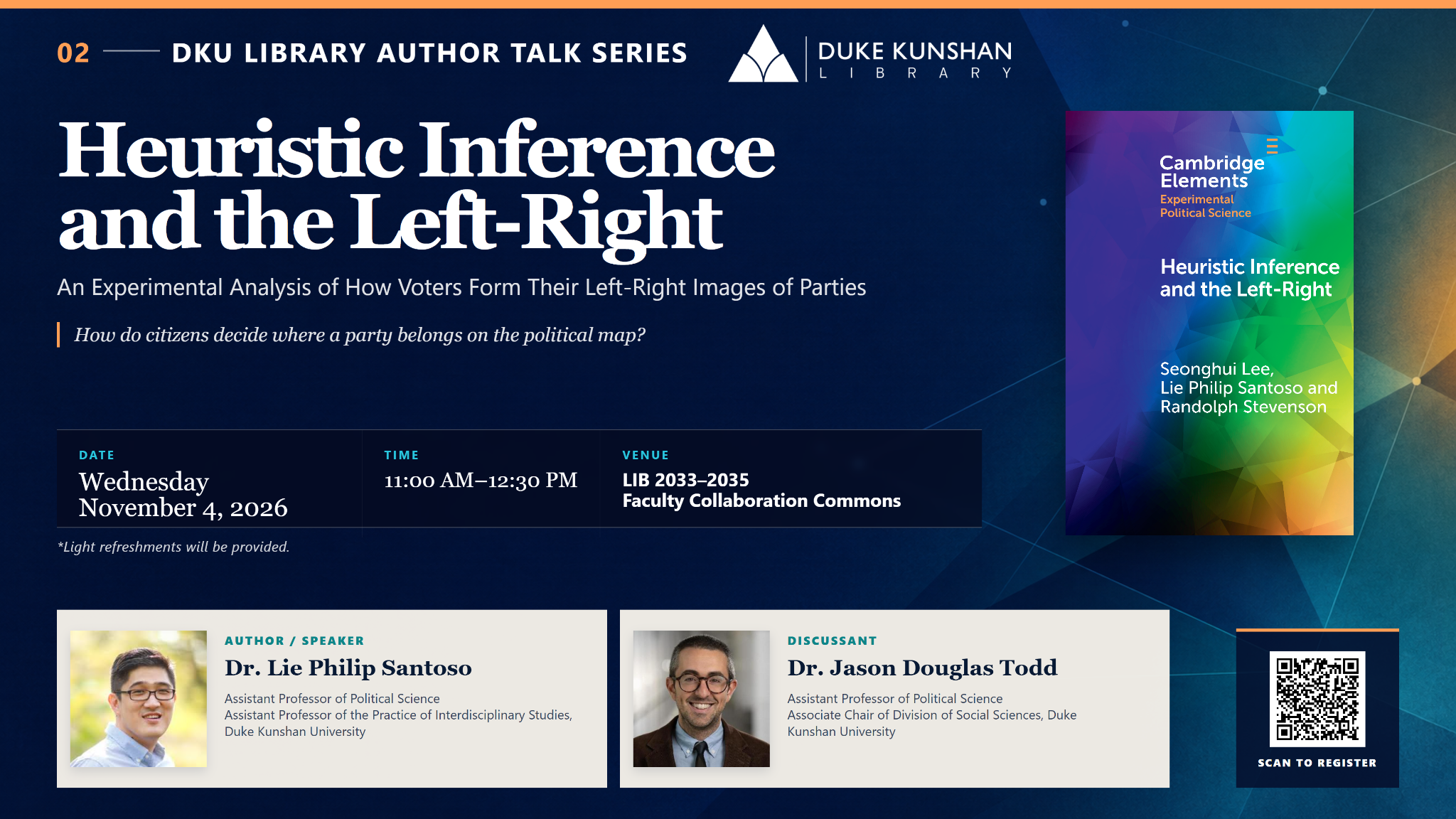
Duke Kunshan University (DKU) Library is pleased to invite you to the latest event in the DKU Library Author Talk Series, featuring Dr. Lie Philip Santoso, Assistant Professor of Political Science at DKU, who will introduce his newly published co-authored work, Heuristic Inference and the Left-Right: An Experimental Analysis of How Voters Form Their Left-Right Images of Parties (Cambridge University Press, 2026). Dr. Jason Douglas Todd, Assistant Professor of Political Science at DKU, will join the event as the discussant.
*Light refreshments will be provided.
Author: Dr. Lie Philip Santoso
Assistant Professor of Political Science; Assistant Professor of the Practice of Interdisciplinary Studies, Duke Kunshan University
Dr. Santoso’s research focuses on comparative political behavior, public opinion, and party politics. His work has appeared in leading political science journals, including Comparative Political Studies and Political Behavior. His latest co-authored publication is part of Cambridge University Press’s Elements in Experimental Political Science series.

Discussant: Dr. Jason Douglas Todd
Assistant Professor of Political Science; Associate Chair of Division of Social Sciences, Duke Kunshan University
Dr. Jason Douglas Todd is an Assistant Professor of Political Science at Duke Kunshan University. His research focuses on American and comparative politics, particularly judicial decision-making, legislative institutions, and the U.S. Supreme Court.
Explore the Book
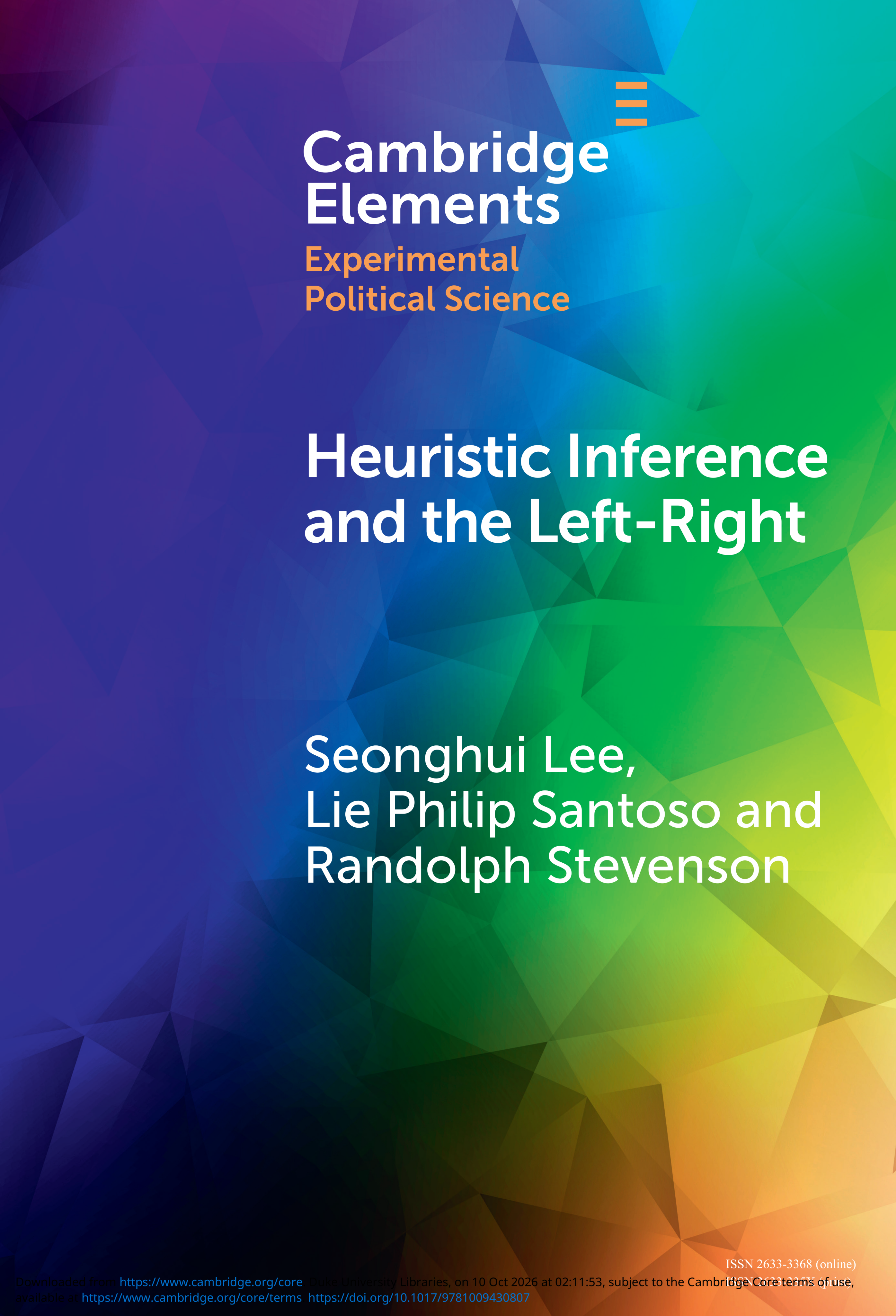
Author: Seonghui Lee, Lie Philip Santoso, and Randolph T Stevenson
ISBN: 1-009-43080-7
Publisher: Cambridge University Press
Publication Year: 2026
Overview:
“Left and right are among the most familiar metaphors in politics. They offer a simple way to express perceived similarities and differences among parties, politicians, and voters, effectively serving as a political map. But how do citizens decide where a party belongs on that map?
In Heuristic Inference and the Left-Right, the book examines how citizens make these judgments. Drawing on survey experiments conducted in Canada, Denmark, Germany, and the United Kingdom, it shows that people rely on a range of cues, including parties’ policies and values, the groups that support them, and the other parties with which they cooperate. It also examines which of these cues are most informative and how citizens with different levels of political knowledge use them to make sense of where parties stand on the left-right spectrum. More broadly, the book examines how citizens use the language of left and right to simplify political complexity and interpret the political world around them.”
Poster & Layout: Liang Yue