
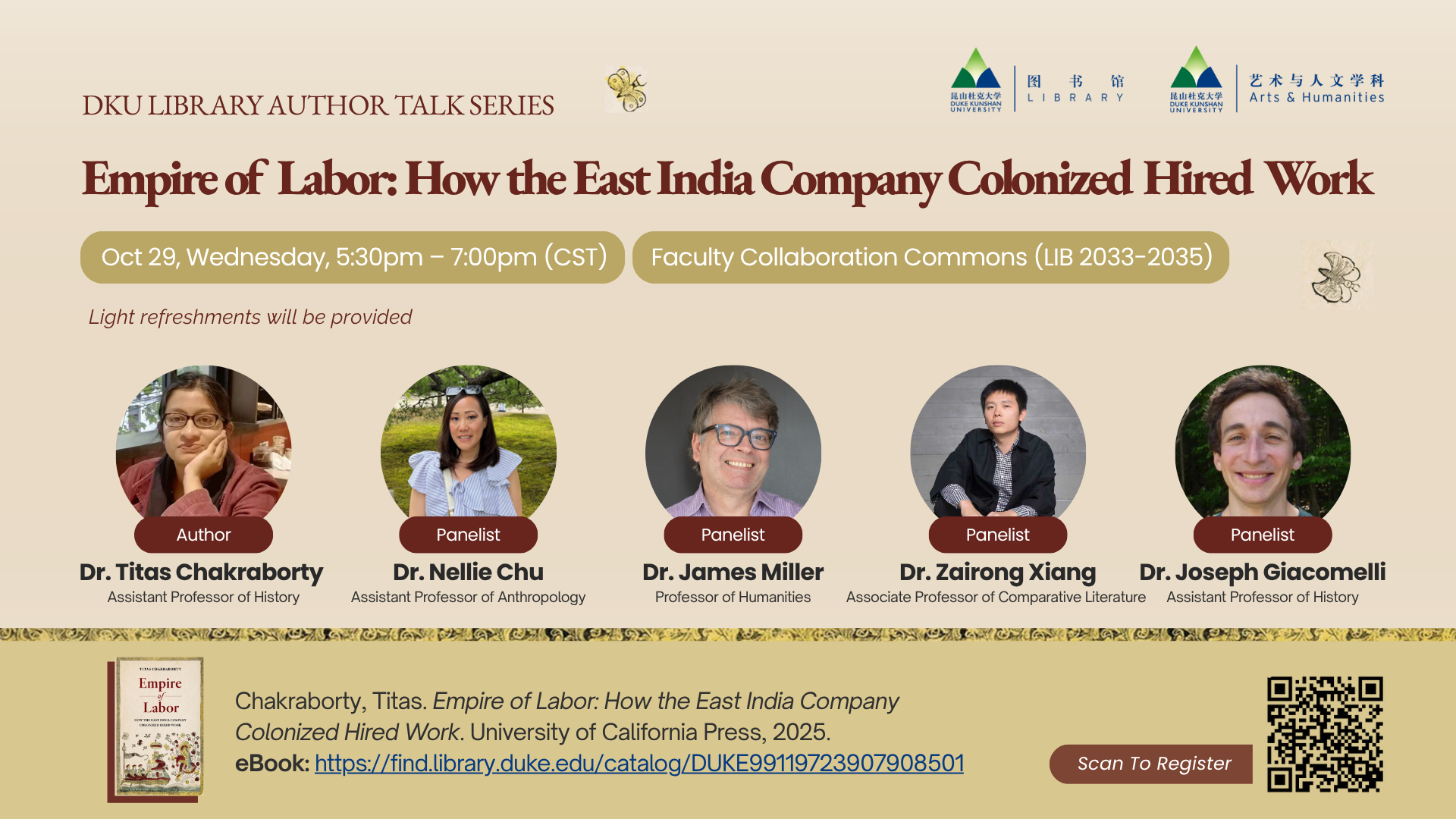
We are pleased to invite you to the latest event in the DKU Library Author Talk Series, titled “Empire of Labor: How the East India Company Colonized Hired Work”. Co-hosted by the DKU Library and the Division of Arts and Humanities, this event is a great opportunity for anyone interested in the intersections of labor, colonialism, and historical narratives.
We are honored to welcome Dr. Titas Chakraborty, Assistant Professor of History at Duke Kunshan University (DKU) and author of Empire of Labor: How the East India Company Colonized Hired Work, to share insights from her book. The event will be presented as a panel discussion, featuring four other panelists from DKU: Dr. James Miller, Professor of Humanities, Dr. Nellie Chu, Assistant Professor of Anthropology, Dr. Zairong Xiang, Associate Professor of Comparative Literature, and Dr. Joseph Giacomelli, Assistant Professor of History.
Empire of Labor: How the East India Company Colonized Hired Work offers a fresh perspective on the rise of English colonial rule in India by focusing on the experiences of hired workers in Bengal during the 17th and 18th centuries. Dr. Chakraborty delves into the lives of a variety of hired workers, revealing how they responded to the state that the English East India Company created in India, which would have far-reaching effects on social life, economic systems, and personal freedoms. Dr. Chakraborty combines methodological boldness with archival riches in Dutch, English and Bengali languages to rethink the meaning of waged work in the early modern peninsula.
In this event, Dr. Chakraborty and panelists will discuss around specific chapters of the book and share their thoughts on these histories. Attendees will gain insight into the intricacies of colonial labor systems and the enduring legacies of these histories in contemporary discussions on labor and colonialism.

Author: Dr. Titas Chakraborty
Assistant Professor of History, Duke Kunshan University
Her research focuses on South Asian and world history, with special attention to labor, migration and gender. Her teaching interests at Duke Kunshan include global China studies, global history and South Asian history. She was a visiting assistant professor at Oberlin College and a postdoctoral research fellow at the Institute for Historical Studies, University of Texas, Austin. Her work has appeared in various journals such as Journal of Social History, International Review of Social History, Slavery and Abolition. She had also co-edited a book, A Global History of Runaways (University of California Press, 2019).

Panelist: Dr. Nellie Chu
Assistant Professor of Anthropology, Duke Kunshan University
Nellie Chu is Assistant Professor of Cultural Anthropology at Duke Kunshan University in Kunshan, China. She has published in positions: east asia critique, Modern Asian Studies, Culture, Theory, and Critique, and Journal of Modern Craft. Her work can also be found in Made in China Journal, Youth Circulations, and University of Nottingham China Policy Institute blog. Her book, Precarious Accumulation, will be published by Duke University Press in February 2026.

Panelist: Dr. Joseph Giacomelli
Assistant Professor of History, Duke Kunshan University
His research examines topics in environmental history and the history of science. In 2023, he published Uncertain Climes: Debating Climate Change in Gilded-Age America, a book which focuses on climate politics in the late 1800s US. At Duke Kunshan University, his teaching interests include U.S. history, environmental humanities, science and technology studies, and geography.

Panelist: Dr. James Miller
Professor of Humanities, Duke Kunshan University
Associate Dean for Interdisciplinary Initiatives, Duke Kunshan University
His research focuses on the intersection of religion and ecology in China. He has published six books including China’s Green Religion: Daoism and the Quest for a Sustainable Future (Columbia, 2017). He is noted worldwide as an expert in Daoism, China’s indigenous religion. His teaching interests at Duke Kunshan University include ethics and leadership, global China studies, environmental science, U.S. studies, religious studies and philosophy.
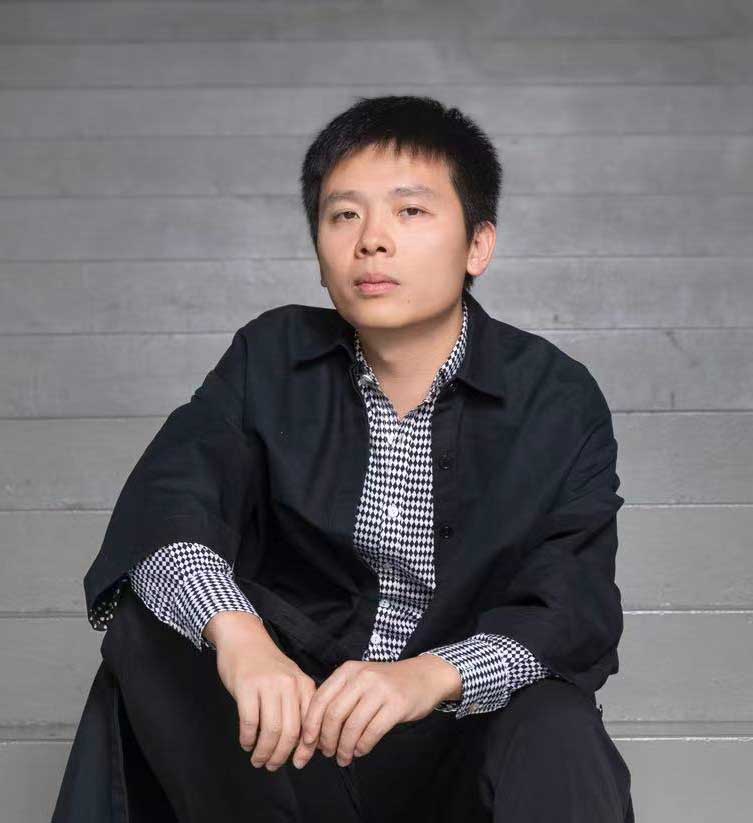
Panelist: Dr. Zairong Xiang
Associate Professor of Comparative Literature, Duke Kunshan University
Director of Arts, Duke Kunshan University
His research, teaching, and curatorial practices engage with cosmology and cosmopolitanism in their culturally diverse, historically specific, and conceptually promiscuous manifestations in English, Spanish, French, Chinese, and Nahuatl. He teaches literature and art at Duke Kunshan University, and was co-curator of the 2021 Guangzhou Image Triennial, Ceremony (Burial of an Undead World) at HKW Berlin, and the 14th Shanghai Biennial Cosmos Cinema.
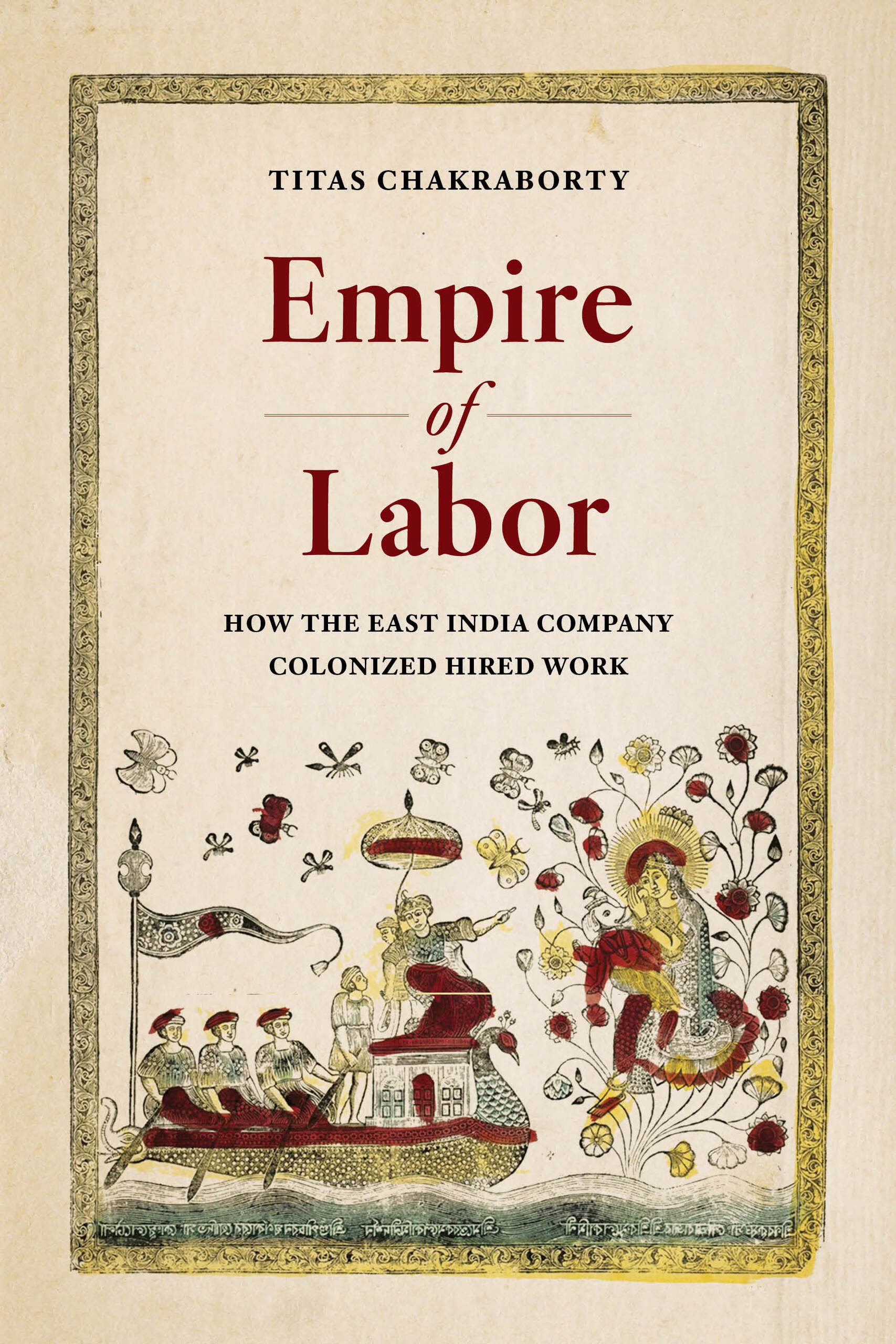
Empire of Labor: How the East India Company Colonized Hired Work
Overview of the book:
Empire of Labor tells the story of how hired workers experienced and responded to the rise to power over the long eighteenth century of the English East India Company (EIC), which perennially hired thousands of people in and around its settlements in Bengal. Focusing on boatmen and silk reelers as well as sailors and soldiers—a remarkable look at both indigenous and European workers—the story begins with the earliest accounts of the EIC’s dealings with hired labor in the region, from 1651. Prior to EIC dominance, hired workers drove hard bargains with their employers, making demands that drew upon their own notions of wages, work rhythms, and time. When their demands were not met, they ran away, often to rival indigenous or European employers. Empire of Labor explores these demands and how they conflicted with the EIC’s notions of discipline. Analyzing Bengali literary sources and Dutch and English archival materials, the book rethinks the ascendancy of the company state as a violent process involving removing competing employers, imposing army and police power, introducing new production technologies, and instituting draconian regulations which eliminated indigenous cultures of work. Most importantly, it depicts the lifeworlds of these recalcitrant workers, showing how they lived and resisted. A major intervention in histories of colonialism, labor, migration, and law, Empire of Labor ultimately recasts colonial rule as a novel form of state-labor relationship.