
At Duke Kunshan University, almost everything we create is digital.
These include:
Imagine a historian 50 years from now trying to reconstruct what it meant to study or teach at DKU in 2025. They would need more than printed reports; they would need access to Word documents, emails, databases, and images once stored on servers, cloud platforms, or even old hard drives.
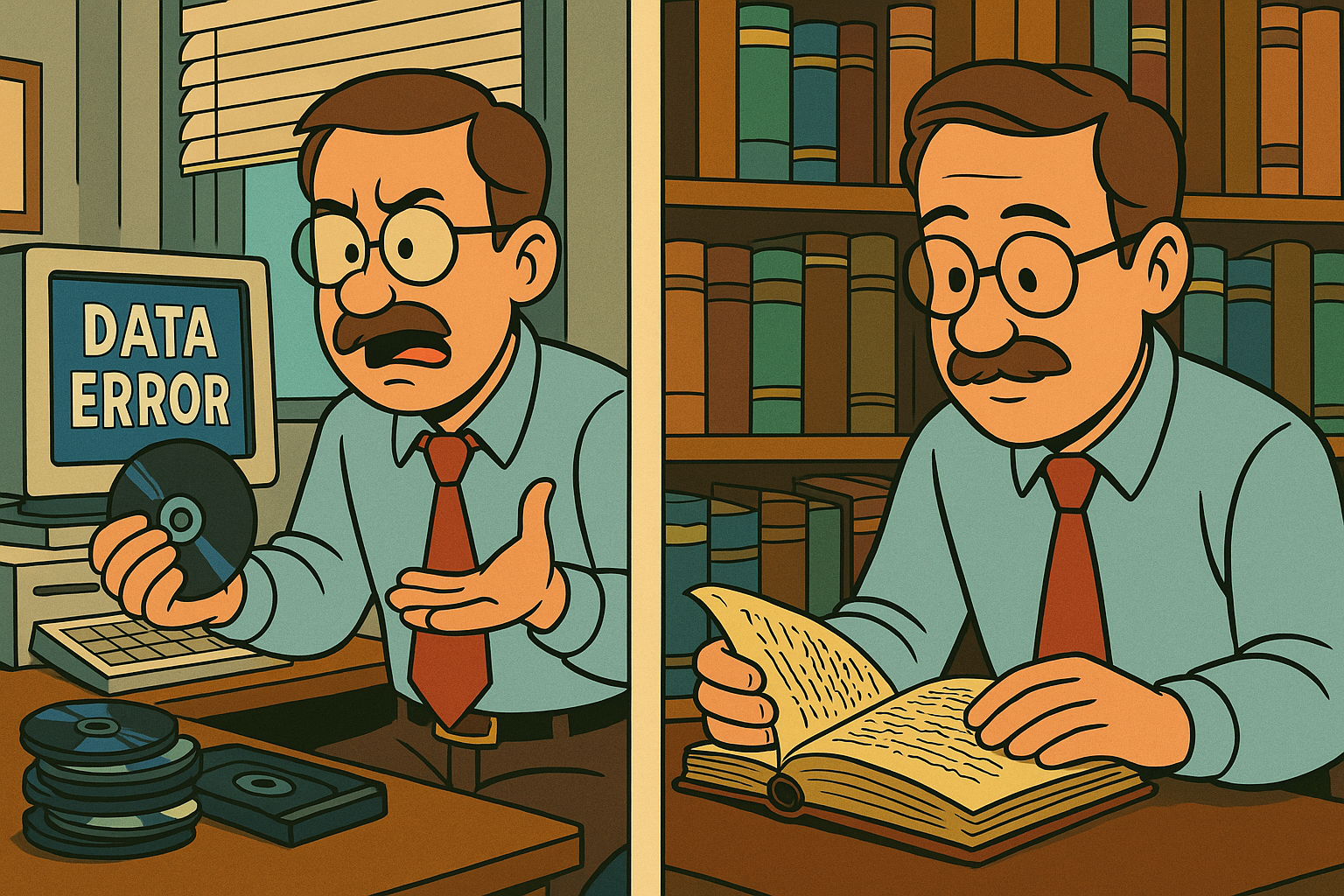
At first glance, it might seem easier to care for modern digital records than for fragile manuscripts or rare books. After all, centuries-old paper requires careful handling and special storage, while a PDF or JPEG is just a click away. But when we think in terms of decades—or even centuries—digital files can actually be much more fragile: formats become obsolete, storage devices fail, and without care, important memories can vanish.
To address this challenge, Duke Kunshan University (DKU) Library has established a world-class digital preservation and access framework:
By implementing these systems, DKU Library supports an OAIS compliant Digital Preservation Program to ensure enduring access to stable and sustainable formats.
Steps in our workflow include:
One of the most important steps in long-term preservation is converting files to preservation formats.
Formats and hardware not listed below may be accepted on a case-by-case basis.
| Record Type | Preferred Formats | Acceptable Formats |
| Textual Records | PDF/A | PDF, TXT, DOC, HTML, DOCX, RTF, ODT, ODP, PPTX, PPT, WPD, XML |
| Images | TIFF | JPG, BMP, GIF, PNG |
| Tabular Data | Original Format | CSV, XLS, XLSX, TSV |
| Audio | WAV | MP3, WMA, FLAC, AIFF, MIDI |
| Video | FFV1/LPCM in MKV | MOV, MPEG-1, MPEG-2, MPEG-4, AVI, FLV, SWF, WMV |
| Websites | WARC | HTML, or submit a list of URLs if websites are still active |
| MBOX | PST, Maildir |
Supported media with current hardware:
With our existing setup (standard computers equipped with DVD drives), DKU Library is currently able to read and image CDs, DVDs, and Blu-ray Discs.
Just as preserving a fifteenth-century book requires expert handling, preserving today’s emails, images, and datasets requires specialized expertise, technology, and ongoing commitment.
By investing in digital preservation now, DKU Library ensures that the story of our university—our research, our teaching, and our student experience—remains accessible not just for us, but for generations to come.