
Author: Mengjie Zou, University Librarian
We began this series because we believe that reading still matters. It is a form of mental training — to read is to understand, to interpret, to resonate, and to think. Just as the Industrial Revolution replaced physical labor with machines, yet humans still go to the gym to keep their muscles strong and flexible, so too, in this age when the AI revolution is gradually taking over the process of thinking, our minds need to stay active through reading and writing. In a way, what the library is doing is — to keep the mind active together with our community.
When planning the first round of One Month One Book, my colleagues and I thought that receiving twenty submissions would already be quite good. To our surprise, by the end of October we had received more than sixty reading titles — a great beginning. Faculty, students, and staff all took part. Most of the books are already in the library’s collection, and those we did not yet have have now been added to our acquisition plan. I carefully read through each review and excerpt; the process was both rewarding and moving, and I was touched by the thought and sincerity in everyone’s writing.
Professor Jason Todd from Political Science read four books this month — two social science works and two Chinese novels, To Live by Yu Hua and Red Sorghum by Mo Yan. In his review for To Live, he wrote:
“It was impossible to put down, and impossible to keep from tearing up as, one by one, Fugui’s loved ones perish in (nowadays) entirely preventable ways.”
It is profoundly moving to imagine an American-born scholar brought to tears by the story of an ordinary Chinese man who, through war and social upheaval, loses everything and ends up living the rest of his life with only an old ox for company. This kind of emotional resonance transcends cultures — much like how we, when reading One Hundred Years of Solitude, sigh over the cyclical fate of a family on the South American continent. At the end of his review, Professor Todd also suggested that the library add more English translations of Chinese literature. We have taken note of this excellent suggestion and will incorporate it into our future acquisitions.
Professor Deng Liuchun from Economics, an avid reader of comics, recommended two graphic novels from the library’s collection:
- Logicomix: An Epic Search for Truth, by Apostolos Doxiadis and Christos Papadimitriou, which explores the evolution of logic and mathematical thought;
- Jerusalem: Chronicles from the Holy City, by Guy Delisle, which portrays the complex history and human struggles of the Israel–Palestine region through the comic form.
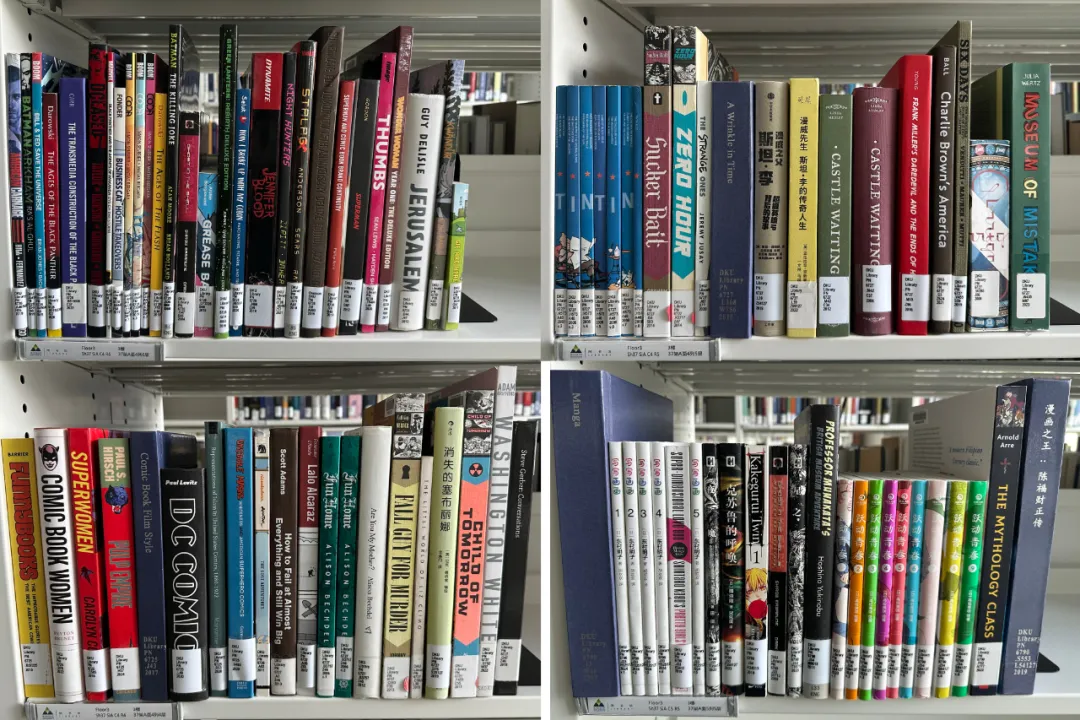
After ten years of building our collection, our graphic novel shelves have grown rich and diverse. I encourage everyone to stop by and take a look sometime — you might discover something unexpected.
The students’ submissions were equally impressive. Among those titles, fiction and nonfiction were almost evenly split. Some chose classics, such as Ruizhi Zhang, who read Maugham’s The Moon and Sixpence; others chose contemporary bestsellers, such as John Simoneaux, who read Tomorrow, and Tomorrow, and Tomorrow (by Gabrielle Zevin, published in 2022). The title, drawn from Shakespeare’s Macbeth — “Tomorrow, and tomorrow, and tomorrow” — is set in the modern world, telling the story of two young creative minds from diverse backgrounds who collaborate in the video game industry, experiencing both artistic triumphs and emotional wounds. It is also a meditation on friendship and love. John shared a memorable line from the book:
“You may not have a romantic relationship with Sadie, but you two will be friends for the rest of your lives, and that is something of equal or greater value, if you choose to see it that way.”
Another recommendation came from undergraduate Anand Bayanmunkh, whose selected title is still being acquired by the library — Prisoners of Geography: Ten Maps That Explain Everything About the World. The author Tim Marshall analyzes how the geographical features of major world regions profoundly shape their political, economic, and military strategies. Once the book arrives, I’m eager to read it myself.
We have published this month’s full reading list and selected reviews on the library website: https://library.dukekunshan.edu.cn/one-month-one-book-october-2025/. The library will continue the One Month One Book program — one round each month, and everyone is welcome to join. By next June, we will review all submissions, and those who have kept up with reading and sharing every month will receive a special gift from the library — a good token to encourage us all to keep a space for thought and reflection in this age of AI.