
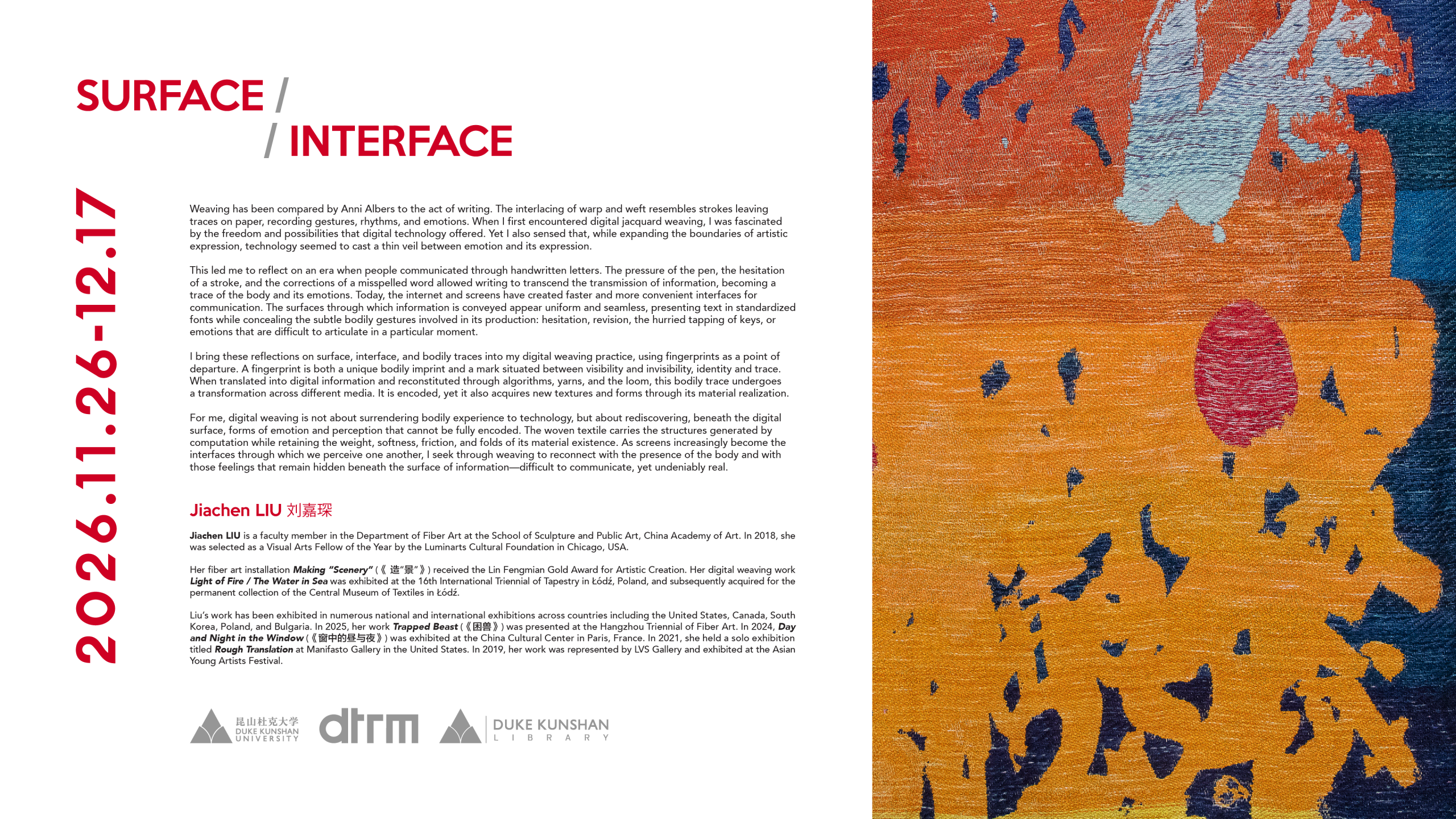
We invite you to SURFACE/INTERFACE, an exhibition by fiber artist Jiachen Liu (刘嘉琛) at China Academy of Art in collaboration with Professor Vivian Xu, Assistant Professor of Media and Art at DKU.
Using digital jacquard weaving, Liu explores how a fingerprint changes as it moves from skin to code to cloth. Just as a pen stroke in a handwritten letter can hint at hesitation or urgency, her woven works invite us to consider what a surface can reveal about the person who left a mark on it.
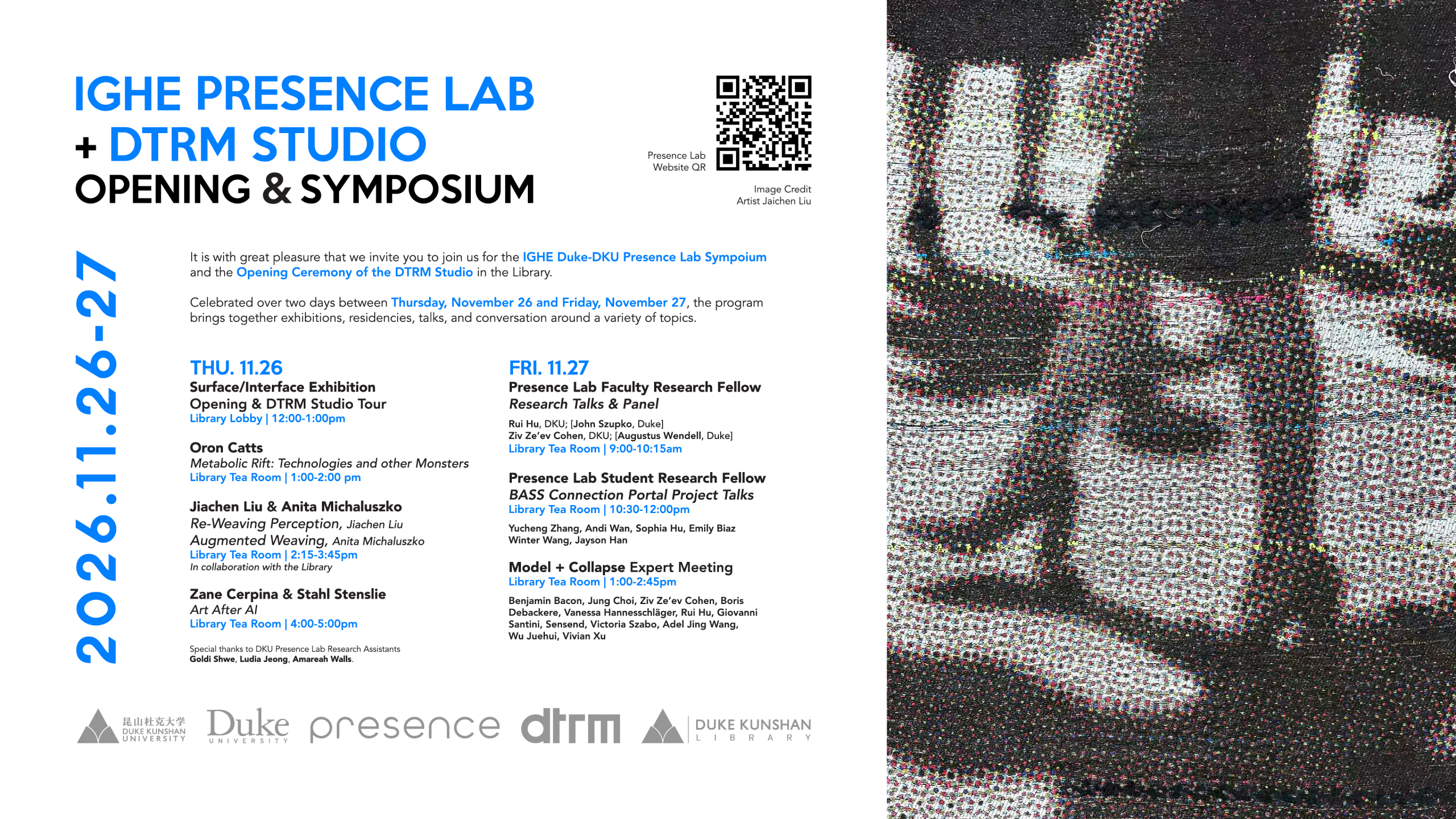
The exhibition opens with a two-day program featuring the opening of the DTRM Studio in the Library and the IGHE Duke–DKU Presence Lab Symposium, bringing together exhibitions, artist residencies, talks, and conversations.
About the Exhibition
Weaving has been compared by Anni Albers to the act of writing. The interlacing of warp and weft resembles strokes leaving traces on paper, recording gestures, rhythms, and emotions. When I first encountered digital jacquard weaving, I was fascinated by the freedom and possibilities that digital technology offered. Yet I also sensed that, while expanding the boundaries of artistic expression, technology seemed to cast a thin veil between emotion and its expression.
This led me to reflect on an era when people communicated through handwritten letters. The pressure of the pen, the hesitation of a stroke, and the corrections of a misspelled word allowed writing to transcend the transmission of information, becoming a trace of the body and its emotions. Today, the internet and screens have created faster and more convenient interfaces for communication. The surfaces through which information is conveyed appear uniform and seamless, presenting text in standardized fonts while concealing the subtle bodily gestures involved in its production: hesitation, revision, the hurried tapping of keys, or emotions that are difficult to articulate in a particular moment.
I bring these reflections on surface, interface, and bodily traces into my digital weaving practice, using fingerprints as a point of departure. A fingerprint is both a unique bodily imprint and a mark situated between visibility and invisibility, identity and trace.
When translated into digital information and reconstituted through algorithms, yarns, and the loom, this bodily trace undergoes a transformation across different media. It is encoded, yet it also acquires new textures and forms through its material realization.
For me, digital weaving is not about surrendering bodily experience to technology, but about rediscovering, beneath the digital surface, forms of emotion and perception that cannot be fully encoded. The woven textile carries the structures generated by computation while retaining the weight, softness, friction, and folds of its material existence. As screens increasingly become the interfaces through which we perceive one another, I seek through weaving to reconnect with the presence of the body and with those feelings that remain hidden beneath the surface of information-difficult to communicate, yet undeniably real.
About the Artist
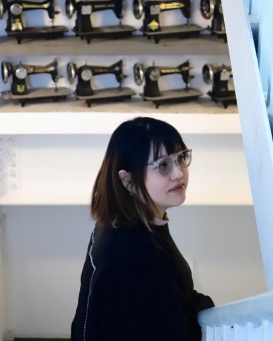
Jiachen LIU is a faculty member in the Department of Fiber Art at the School of Sculpture and Public Art, China Academy of Art. In 2018, she was selected as a Visual Arts Fellow of the Year by the Luminarts Cultural Foundation in Chicago, USA.
Her fiber art installation Making “Scenery” (《造“景”》) received the Lin Fengmian Gold Award for Artistic Creation. Her digital weaving work Light of Fire / The Water in Sea was exhibited at the 16th International Triennial of Tapestry in kódz, Poland, and subsequently acquired for the permanent collection of the Central Museum of Textiles in kódz.
Liu’s work has been exhibited in numerous national and international exhibitions across countries including the United States, Canada, South Korea, Poland, and Bulgaria. In 2025, her work Trapped Beast (《困兽》) was presented at the Hangzhou Triennial of Fiber Art. In 2024, Day and Night in the Window (《窗中的昼与夜》) was exhibited at the China Cultural Center in Paris, France. In 2021, she held a solo exhibition titled Rough Translation at Manifasto Gallery in the United States. In 2019, her work was represented by LVS Gallery and exhibited at the AsianYoung Artists Festival.