
How is artificial intelligence reshaping the global economy? What does technological change mean for economic growth, employment, and inequality?
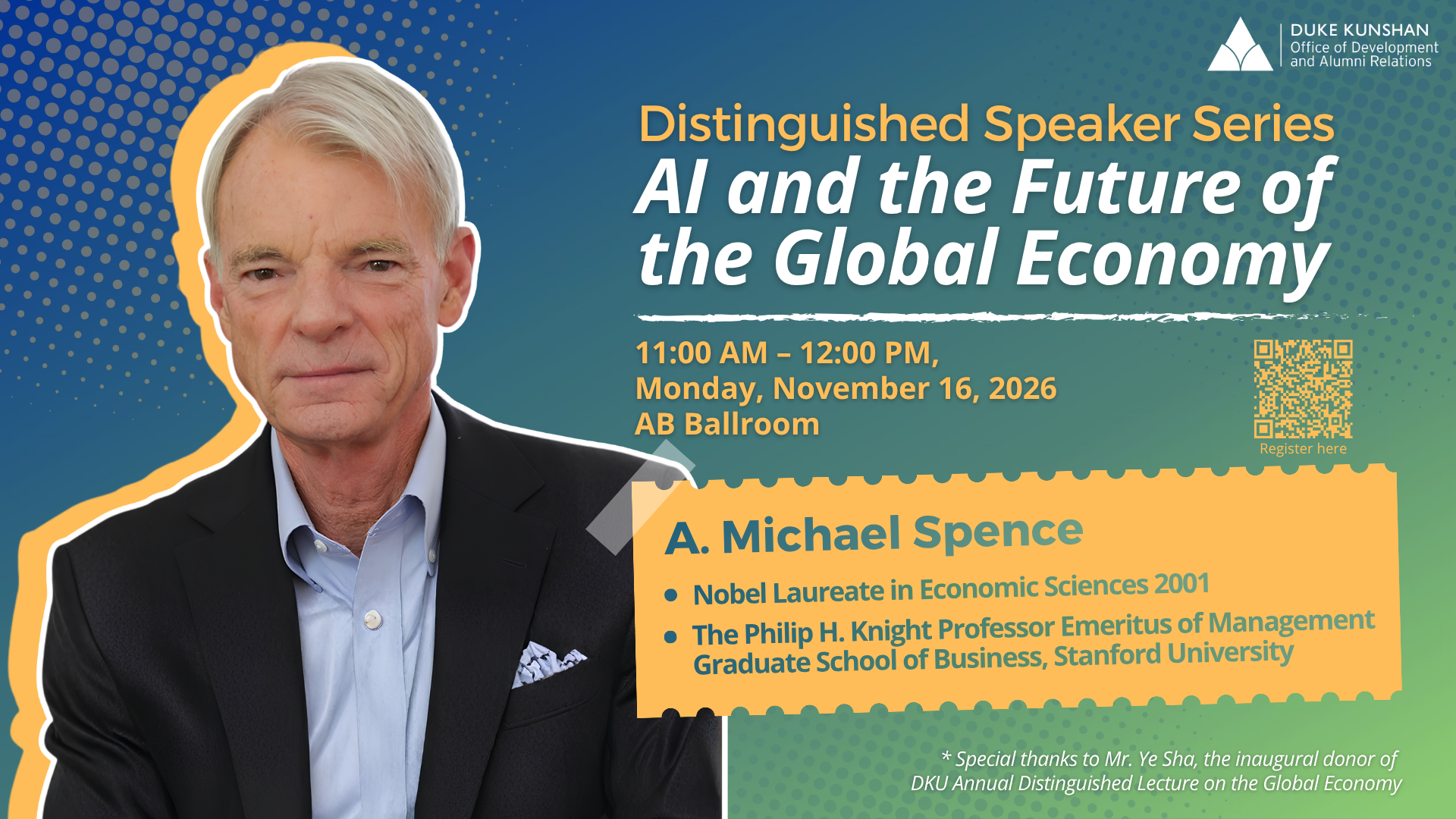
On Monday, November 16, 2026, Duke Kunshan University’s Distinguished Speaker Series welcomes A. Michael Spence, recipient of the 2001 Nobel Prize in Economic Sciences, for a public lecture titled “AI and the Future of the Global Economy.”
Drawing on his extensive research in information economics, economic growth, and global development, Professor Spence will explore how artificial intelligence may transform labor markets, economic opportunities, and the global economic landscape.
To accompany this event, DKU Library invites readers to discover his influential research and explore a selection of books that connect economic theory with the challenges facing today’s world.
Lecture Information
- Speaker: A. Michael Spence, 2001 Nobel Laureate in Economic Sciences
- Title: AI and the Future of the Global Economy
- Time: Monday, November 16, 2026 | 11:00 AM–12:00 PM
- Venue: AB 2F Ballroom
01 Meet A. Michael Spence
2001 Nobel Prize in Economic Sciences
A. Michael Spence is the Philip H. Knight Professor Emeritus of Management at Stanford Graduate School of Business, a Senior Fellow at the Hoover Institution, and a Senior Professor at Bocconi University. He previously served as Dean of Stanford Graduate School of Business (1990–1999) and Dean of Harvard University’s Faculty of Arts and Sciences (1984–1990).
In 2001, Spence shared the Sveriges Riksbank Prize in Economic Sciences in Memory of Alfred Nobel with George A. Akerlof and Joseph E. Stiglitz for their analyses of markets with asymmetric information.
Spence is especially known for his work on market signaling, which explains how individuals with private information can communicate information that others cannot directly observe. Education, for example, may serve as a signal to employers about a job applicant’s productivity.
His later research examines economic growth and development, the changing relationship between advanced and emerging economies, and the policies that shape long-term prosperity.
From information asymmetry to artificial intelligence, his work offers valuable perspectives on how economies respond to uncertainty, innovation, and global change.
02 Begin with the Big Questions through DKU Library
Begin your exploration of Michael Spence’s economic thinking with the following books available at Duke Kunshan University Library.
| Title | Author | Library Collection |
| The Next Convergence: The Future of Economic Growth in a Multispeed World | Michael Spence | HD82 .S694 2011 |
| 阿克洛夫, 斯彭斯和斯蒂格利茨论文精选 | 乔治·阿克洛夫、迈克尔·斯彭斯、约瑟夫·斯蒂格利茨 | HC79.I55 A437127 2017 |
| Competition in the Open Economy: A Model Applied to Canada | Richard E. Caves, Michael E. Porter, A. Michael Spence, John T. Scott | HD70.C2 C38 1980 |
| Permacrisis: A Plan to Fix a Fractured World | Gordon Brown, Mohamed El-Erian, Michael Spence, Reid Lidow | HN18.3 .B76 2024 |
| Health and Growth : Commission on Growth and Development | Rawat Rawat Publications, Michael Spence, and Maureen A. Lewis | EBOOK |
| Urbanization and Growth | Michael Spence, Patricia Clarke Annez, and Robert M. Buckley | EBOOK |
| Leadership and Growth | David Brady and Michael Spence | EBOOK |
| Equity and Growth in a Globalizing World | Ravi Kanbur and Michael Spence | EBOOK |
| Globalization and Growth : Implications for a Post-Crisis World | Michael Spence and Danny Leipziger | EBOOK |
| In the Wake of the Crisis: Leading Economists Reassess Economic Policy | Edited by Olivier Blanchard, David Romer, Michael Spence, Joseph E. Stiglitz | EBOOK |
| A Context for a Renewed Economics | Michael Spence, David Mitchell | Coming Soon |
03 Beyond Spence: Explore More Nobel Laureates in Economic Sciences
Michael Spence’s contributions are part of a broader tradition of economic research examining how markets, institutions, technology, and human behavior shape society.
DKU Library also offers resources by other Nobel laureates in Economic Sciences. Explore selected works spanning behavioral economics, poverty and development, financial crises, labor markets, and institutional change.
★Selected Works of Nobel Laureates in Economic Sciences (2016–2026)★
These titles provide additional starting points for understanding contemporary economic questions through the work of Nobel Prize-winning scholars.
04 Continue the Economic Conversation
From information asymmetry and market competition to globalization, economic development, and artificial intelligence, Michael Spence’s work encourages us to consider how economic systems evolve and how societies can respond to new challenges.
Whether you are interested in business strategy, public policy, technological innovation, or global development, these books offer opportunities to explore the ideas shaping our economic future.
Join us on November 16 for “AI and the Future of the Global Economy,” and continue your exploration through DKU Library’s print and electronic collections.